


Presentation: We believe you will find our ‘no-frills’ content useful, effective, and engaging. But please do go over this introduction before clicking to specialist pages as here you will begin to understand what GladiatorTraining.biz offers you.
Our material is practical rather than academic, offering genuinely effective tips and tricks alongside core skills. We share teachings and quotes from leading historic personalities, statesmen and -women, business gurus, philosophers, and sage-warriors.
To see what's in store for you in the section and the pages that follow, click or hover your mouse over the a coloured italics below.
In this website, you can download
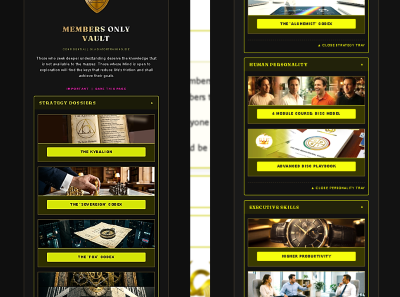
 quick reference guides or—if you want to dive deeper—via our inner-circle Membership you can even get special dossiers
 and otherwise-restricted pages with genuinely valuable material.


GladiatorTraining
PRINCIPLES:
• No single technique works 100% of the time
so anyone claiming otherwise is not being entirely honest. Different circumstances may require different techniques. A 'one-solution-fits-all' guarantee is generally 'hype'. An exaggeration. That is why we offer a range of techniques—to ensure you are well prepared.
Look for what resonates with you, and use what works best for you. Although what we provide is tried and tested, the choice is ultimately yours.
• Follow these GladiatorTraining maxims:
♜ "to know stuff is not enough!"
You can only become an expert by putting knowledge into practice. There is NO other way! Pure and simple.
♜ “People will understand ... according to where they stand.”
Where they 'stand' is the result of their personal life experiences, which are not the same as yours. Every individual is different from you—yes, even those who agree with you on most things—so you mustn't assume that what you believe is what they believe, or that what you value (what's important to you) is also important to them.
♜ “I cannot open your lock ... using my own key.”
Following on the previous rules, you need to understand which technique works with the other person, what communication style—explained in the website—the other person uses. Observe, adapt, calibrate, and apply the one that fits their lock.
EXPLORE THE PLATFORM:
You'll find teachings from a number of ancient sources being applied to your corporate realities. Of course, we also draw on the wisdom of modern experts, clearly explained and applied to practical, everyday scenarios.
Click the following headings to explore a variety of topics, each leading to a network of pages with knowledge that's often omitted from Courses—perhaps by oversight or for some other reasons.. Are you ready to explore?
▶ click the tabs below to expand.

Discover your preferred style for navigating through life and your career, represented here as your natural Strategic Archetype
 .
Take the Strategy Assessment
 In business, ‘Strategy’ is your gameplan in a world that operates as it is―not as we wish it to be―one that must reflect the world's reality.
We evaluate your responses to 24 practical scenarios, interpreting them through the lens of ancient strategic doctrines and the 7 Hermetic Principles.
and download your results, complete with tailored advice on improving your approach to minimise friction. Although there are no right-or-wrong styles, certain
tactical behaviours
 Upon completion of your Strategy Assessment, you'll get an Evaluation that explains your natural style as well as recommending alternative responses that are more in alignment with a leadership role, while creating least friction.
You may then download your personal results as a .pdf file or email them to yourself at the push of a button.
can help you reach your objectives with less resistance.
Those of you who prefer more control needn't worry as we also tackle the very much misunderstood Machiavelli and the important realities he exposes, so whichever strategy suits you, we cover it. The material is being baked. Let's proceed to the:
▶ Strategy Audit questionnaire;
▶ Eight Pillars of Negotiation pdf download;
▶ Seven Hermetic Principles pdf download;

Contrary to popular belief, people project more than one personality depending on their circumstances and roles at any one time.
It is true that you have a natural predisposition—or preference—towards one, default personality type, and the Enneagram system emphasises this. But it is equally true that your behaviour often adapts to what is appropriate in a situation. At that point, you will be projecting an "adaptive persona ". Now it is extremely important to understand that 'adapting' to circumstances does not make a person 'fake'!
In this section, we explore different personality frameworks, with particular emphasis placed on the DISC Model
 Of all the Personality Types frameworks, the DISC Behavioural Model is probably the most practical and useful, besides being the easiest one to understand.
If you're a visitor exploring this resource for the first time, you will find priceless teaching here, but we dive even deeper for those who choose Membership, where knowledge goes well beyond 'training' standards. Learn about the Hybrid Human by following the
link.
, which is perhaps the easiest tool you’ll find in this area, without downplaying others. You may indulge in our pages:
▶ Introvert-Extrovert explanation;
▶ Jungian Persona clarification;
▶ The Myers-Briggs Type Indicator;

The belief that “some are born to lead and others to follow” is largely false.
Yes, some people do have a natural predisposition
natural predisposition
Some personalities have a more dominant nature and some prefer to maintain control as we see when exploring the DISC Model, but actually all personality types have the potential to be leaders.
Two of the four main DISC Types – the task oriented "D" and the "C" – lean towards Management, while the other two – the people oriented "I" and the "S" – lean towards Leadership. A corporate executive needs both managerial and leadership skills to be effective.
to take the lead, while some prefer to leave decisions and planning to others, but leadership is a 'skill' and not only can it be developed, but it's actually one that most of us probably already use – at different levels and in different situations – as parents, or even within you job level.
related links:

We are not concerned with high-strung academic theories since our primary objectives
 here are very clear: "to connect with people and convey clear meaning so as to achieve a particular purpose," which includes influencing others.
In Training, we dive into the essential principles of effective communication
Effective communication lands your message directly in the listener's Mind. For the best results, you should use both channels:
▶ the one speaking to their rationale—verbally; and
▶ the other to their subconscious processor—non-verbally.
What is covered in Training? scroll down
We explain and demonstrate how the 'non-verbal' overrides the 'verbal.' Other topics include image- and emotion-inducing verbal-language, effective non-verbals/body-language, principles of persuasion, rhetorical devices (tools that are especially useful for Public Speaking), and other techniques.
Specifically in Public Speaking training we also cover dealing with 'nerves'—often referred to as 'stage fright'.
Please email your enquiry providing details of your organization and needs.
, going on to reveal techniques—including some used by "con artists" and others developed by "hypnotherapists".
You will see how some techniques are better suited for one-on-ones or small-group interactions, while others are geared for public speaking
 , whether you're giving a speech from a stage or podium, pep-talking your team, or making a presentation.
It is essential to remember that communication style is hugely affected by two types of conditioning: Personality Type and Culture.
Proceed to the:
▶ Communication Style Assessment;

Aside from our signature Leadership and Communication training, we also deal with related soft skills such as Decision-Making, Negotiating and what is commonly—and erroneously—known as ‘Time Management,’ which we prefer to label as Efficiency, or Productivity in our training.
Other important topics in this Chapter include "the Art of Observation," which is especially essential when conducting negotiation or when combating manipulation techniques—which we also refer to under the "Strategy" chapter. We also provide dossiers about this in the website.
At the very least, you'll learn how 'not'
to allow others to manipulate you!
Like with any other combat skill — you shouldn’t go around manipulating people, but you become capable of defending yourself against their outright (or underhand) tactics, including covert offensives you might not have recognized in the past.
New topics are added regularly, meanwhile, you can proceed to the:
▶ Higher Productivity Members' Dossier;
▶ Negotiating skills – for professionals;
▶ Running Meetings – effectively and productively;

Meetings can be a great waste of time unless they are run efficiently. Consider the different personalities, maybe even different cultures, different communication styles, and different personal agendas ... all these can contribute to chaos unless someone keeps the meeting disciplined and focused.
The skills required are quite simple and we lay down the essentials in our dedicated pages. If your meetings are unproductive, or if they need improvement, you can benefit from our briefings.
Proceed to the following pages:
▶ Running Meetings – effectively and productively;

Training Services: Training Organizations and other Corporations wishing to engage GladiatorTraining in our specialist topics may discuss this on an ad hoc basis.

