As you know, so many people are interested in astrology. Although this has no relation to Personality, however, it highlights a natural human tendency or desire to categorise people into groups. Astrology uses the 12 Zodiac Signs to represent different "types" of people.
Since every person is a unique individual—and studying more than eight billion individual personalities is impossible—the 'frameworks' that follow each group humans into a small number of "personality types".
This helps us better understand human patterns. Some frameworks focus on personal traits, others on human behaviours and others on underlying drives. For this reason, we bring you these four popular, useful systems, which are explained in a way that anyone can grasp their benefits. Feel free to adopt the one that feels easiest or most useful to you. Happy observing!
There are several popular frameworks used today. While currently only 'The Big 5' is fully backed by academic consensus, the others remain highly practical tools for personal development and for corporate efficiency.
Before clicking to explore any of the frameworks described below, here are a couple of important and fair considerations:
- Introversion and Extroversion are primary factors in the following systems, so you really need to know the truth (rather than the common misconceptions) about this topic. Open this separate page before tackling any of the frameworks in depth. Then return here.
- Jung's "Persona" is another indispensible topic that you must be fully familiar with as it affects every one of the frameworks, and we tackle this in depth. So, open this separate page too before moving to any of the framework pages once you've read the descriptions (below). Return here after the Persona lesson.
The Big Five (OCEAN)

This model is widely considered by psychologists to be the most scientifically reliable. It measures five core personal traits, forming the acronym OCEAN:
Openness, Conscientiousness, Extraversion, Agreeableness, and Neuroticism.
A person is scored along a spectrum [between high and low] for each trait so, for example, one may score low in Openness, medium in Conscientiousness, high in Extroversion—being the equivalent of low Introversion—etc.
These traits would explain a person's state and behaviour in different circumstances. So each of us would score on all five resulting in a combination of highs and lows in the five traits that come together to identify our personality within this framework.
▶ Explore the Big 5
Reminders:
▶ Introvert or Extrovert?
▶ Jungian Personas 101
The Myers-Briggs Type Indicator (MBTI)

Created by Katharine Cook Briggs and her daughter Isabel Briggs Myers, this system builds on the theories of legendary psychiatrist Carl Jung. It is highly popular in corporate training and reputedly favoured by the CIA in teaching recruits.
This system divides people into 16 distinct personality types based on a combination of preferences: A choice is made out of two options. This is repeated across four scenarios, resulting in 4 letters—reflecting their 4 choices—that determine the personality type within this framework.
If we compare this to the "Star Sign" archetypes, in the MBTI framework, your choices classify you into one of 16 type s that sound very much as you would describe yourself. Of course, they are based on your own input.
▶ Explore Myers-Briggs
Reminders:
▶ Introvert or Extrovert?
▶ Jungian Personas 101
The Enneagram
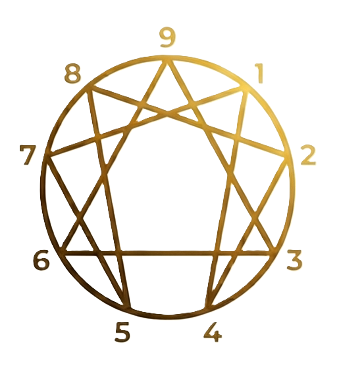
This model uses 9 primary personality types and it focuses on a person's core motivations and fears. It suggests that while we do have a dominant type, we also share traits with neighbouring types. In fact, we call the 9 primaries: "archetypes". These then group into 3 principle clusters.
Some people question how seemingly different archetypes could be grouped into a single cluster, and we shall explain this very clearly in the Enneagram chapter. Remember, this is not about behaviours as such, but what causes them.
Remember also that in life we play different roles—exercising different levels of authority, responsibility and confidence—and our personality often shifts as would be appropriate to these different personas as a way of navigating the day.
▶ Explore the Enneagram
Reminders:
▶ Introvert or Extrovert?
▶ Jungian Personas 101
The DISC Behavioural Model
Developed by psychologist William Moulton Marston, this framework connects to ancient behavioural concepts. It uses four main categories: Dominance, Influence, Steadiness, and Compliance. Most people have a primary quadrant, followed by secondary and tertiary traits.
We cannot overemphasise that nobody has one fixed personality at all times. Depending on circumstances, we often glide into and out of different aspects of our total personality; sometimes you might be assertively defiant whereas you might generally be mild mannered, or you might be a people person at work but long to get home for some quiet recovery time. This is explained in some detail on the pages that follow. As we say, you are a 'mosaic' of traits, behaviours and drives.
The DISC Model is perhaps the easiest of the four to apply in assessing other people's preferences because behaviour is an outward expression whereas traits and motivations might be more difficult to discover unless you have the opportunity to observe a person over a substantial period. DISC will help you choose your communication style and the appropriate approach to gain trust and compliance. The key is adaptation.
▶ Explore the DISC Model
Reminders:
▶ Introvert or Extrovert?
▶ Jungian Personas 101
In this website, we explain all four frameworks simply and clearly. Owing to its practicality, we cover the DISC framework in added detail. Members can follow training modules accompanied by an extensive manual.
However, it is essential to remember that no personality is completely fixed. That we change between different segments of our personality during any given day, and that every framework has its merits.
Understanding these frameworks helps us navigate relationships and improve how we work with others, whose personality is different from ours. Now, if there were only one piece of advice we'd like you never to forget in regards to personality, it would be this:
Calibrate! Don't rely only on your first observations, and don't simply guess. Look for evidence, then check again, because over a period you are likely to discover that your first observations were not enough.
Choose which of the frameworks, above, you would like to explore first or click the button to continue exploring in sequence.
But remember to look into the Jungian Persona and Intro-/Extroversion pages first:


 Understanding what drives behaviour is crucial so as to navigate relationships more consciously and beneficially.
  .
.