
in meetings

This section is not about Corporate Culture—the personality of a company that determines 'how people are expected to behave' inside the organization—but about Global Culture.
This is about people from different ethnic origins—whose lives have been conditioned by different geographical, historical and political circumstances since the day they were born—how they behave, what they value and believe.
But we'll limit our observations to the Meeting Room as different cultures meet ... and sometimes clash. It's about understanding the dynamics to limit, or eliminate, friction.
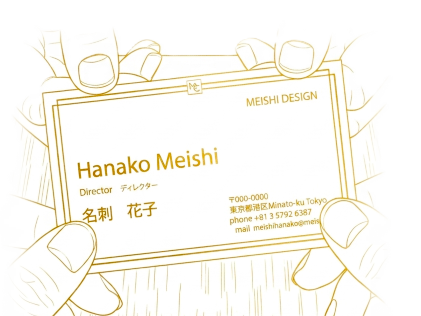
Business Cards: This might sound trivial to you if you are a westerner, but be sure to receive their card as they present it. If your counterpart is from Southeast Asia — particularly from Japan and South Korea, but also China and the SE continent — they will be using 'both hands'. Show interest, courtesy and respect as you receive their business card.
In such cases, also present your own card holding the two corners as if presenting a picture. A little courtesy can go a long way in building relationships. Your best bet is to let them go first and follow their manner.
Understanding Time: Western culture—North America, Western to Central Europe, and Australia—highly values punctuality and the strict keeping of deadlines, whereas non-Western cultures generally view 'time' in a different light—as rather flexible.
It is not perceived or intended as disrespect by the North African, or Mediterranean parties who treat target dates as an 'intention' – unlike their Northern European or American counerparts who would stake their 'reputation' on delivering before the deadline expires.
This is hard cultural conditioning; a tradition that solidified over the ages. And yet, this underestimated reality of cultural diversity often comes as a surprise and as bad medicine for both parties when a deadline is missed.
If a deadline is agreed upon because the success of a project depends on it, then it should be greatly stressed and included in a written agreement along with any financial consequences for default. In the case of such a time-sensitive project, following up regularly to ensure progress is on track is solicited.
Refer to Rule #1 in our: 3 Rules article.

Communication styles vary widely between Western and non-Western cultures.
Cultural Context: The word 'context' can be explained as 'background knowledge.' People with a medical background, for example, may more easily understand medical reports, given their exposure in that field. Similarly, people of a certain culture would often understand nuances of language and gestures, as well as concepts in which they would have been brought up. This is more true for certain (homogenous) cultures than others, as we shall see, and it is potentially due to their limited or no influence from external cultures.
▼ Low Context: In Western culture, we place great emphasis on being clear, precise and direct, so as to avoid risk of misunderstanding. In a business context, we prefer to summarise (repeat) the conclusion, or agreement reached and then to follow up in writing.
▲ High Context: In other cultures, this explicitness, repetition and spoon-feeding is often considered as being "too much" and unaceptable. Instead, they rely heavily on trust and non-verbal understanding, which low context culture then considers to be risky! Non-Western high context cultures broadly include the Middle and Far East, South America, Africa, and Southern (Mediterranean) Europe.
⚠ Negative Feedback: When it comes to giving and receiving negative feedback (criticism) some nationalities are known for their direct, honest and unsweetened expression, while others prefer a softened, indirect approach, with direct negative criticism potentially causing them embarrassment, or even loss of face.
Here, we have a division within Western Culture. The British Isles and North America generally prefer overly safe feedback, to avoid bad feelings, so criticism is often given 'watered-down.' Countries like Japan are famous for face-saving ethics.
Meanwhile, countries like Germany and the Netherlands are known for giving and expecting direct feedback that can feel blunt (harsh) to the others. When it comes to directness in giving negative feedbackc, the previous cultural divisions [related to context] do not apply.
Ultimately, when dealing with persons of dissimilar cultures, you should study the communication styles prevalent in their regions so as to avoid misunderstanding or misinterpretation. This includes 'non-verbal' gestures that might be acceptable in one country but offensive in another.