
Created by Katharine Briggs and Isabel Briggs Myers, based on the work of psychologist Carl Jung, the
Myers-Briggs Type Indicator® (MBTI)
The MBTI Assessment:
A practical tool that helps you understand how different people prefer to take in information, make decisions, and focus their energy. It organizes these natural habits into 16 personality types.
is a clear, practical guide to understanding how people think and behave.
Unlike medical tests, MBTI does not look for flaws or mental health problems. It does not measure your intelligence, talent, or skill. Instead, it simply shows which mental habits feel most natural to you.
IMPORTANT: If you haven't done so already, please ensure you go over our Jungian 'persona' and introversion/extroversion chapters to avoid any misconceptions and to have better understanding of what follows.
Core Rule: All 16 personality types are equally valuable. The goal is to understand your natural habits while learning to adapt your behavior when a situation requires a different approach.
Click any 'pair' [below] to compare the two opposite choices in the panel [beneath]
Where you get your energy and direct your attention.
How you take in information and notice details. Physical senses, or gut feeling?
How you make choices and evaluate options. Rational or Emotional?
How you like to organize your day and surroundings. Planning or in the moment?
From each of the pairs, above, identify the characteristic that suits you best and take note of its assigned 'letter.' So, for instance, if you lean towards "introversion" then your letter is "I". If you are the "intuitive" type, then your letter is "N". Ultimately, you end up with a four-letter code, e.g. ESTJ or INFP.
Note: Here, it is worth remembering that we project different 'personas' during each day, so you might find more than one set of letters suit you. It is a practical reality that an introverted person, for example, might behave as an extrovert professionally.
That being said, however, MBTI is designed to measure your most natural preference, not the temporary 'personas' you put on to meet the demands of your job or role, such as family life.
Behind each of the 4-letter codes mentioned above lies the real engine of personality:
Cognitive Functions
Cognitive Functions:
The specific mental processes we use to gather information and make choices. Each function works either outwardly with the world around us or inwardly within our own minds.
.
Every person uses four mental tools [functions] during each day—and in a specific order. Think of your mind as a vehicle, where these four tools represent how you operate.
▶ Click the headings below for an explanation of each function:
In business and everyday life, MBTI helps you adapt your behavior intentionally. Understanding personality types allows you to build stronger teams, solve disagreements calmly, and communicate clearly.
The following diagram is taken from our DISC Model chapter, explaining how the same person slides between 'adaptive behaviour' not only between different roles, but sometimes even within the same one. The two middle elements in the diagram demonstrate this.
Understanding behaviours is crucial to minimizing friction in any situation.
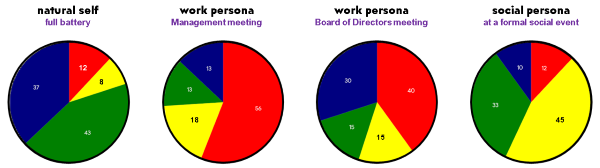
[ ADAPTING YOUR WORK STYLE TO DIFFERENT ROLES ]
Thinking (T) leaders focus naturally on clear logic, facts, and results. Feeling (F) leaders focus naturally on team morale and harmony. Great leaders learn to use both styles so they can give clear instructions while keeping the team motivated.
Friction often happens between Judging (J) and Perceiving (P) types. The J-types need firm plans and early decisions while the P-types naturally keep options open for new information. You can solve this by setting firm deadlines while letting people choose how they work day-to-day.
Match your message to what the other person values most:
➽ For Sensing (S) people: Share clear facts, real numbers, and step-by-step examples.
➽ For Intuitive (N) people: Focus on the big picture, future ideas, and creative possibilities.
Click the heading, above, ▲ for the explanation.
True personal growth happens when self-awareness helps you understand others better. Knowing your own type shows you where you can improve; knowing another person's type shows you how to work well with them without misunderstandings.
How do we ascertain other people's type? Don't guess. Don't jump to conclusions. Observe, and calibrate! Then calibrate some more!
Understand what causes you stress, manage mental exhaustion, and practice making choices using logic as well as personal values.
Instead of asking "Why are they being difficult?" you can ask "Which style are they using?" This makes teamwork smoother and reduces frustration.
IMPORTANT WARNING: MBTI shows personal preferences, not fixed limits. Never use your personality type as an excuse for poor behaviour (for example, saying, "I'm a Thinking type so I don't need to be polite").
MBTI measures preference, not ability. People's performance is indeed affected by their personality, which may make them more/less suitable to particular kinds of work, yet people of any type can succeed in any career with proper practice, motivation, and training.
Personality is fluid, not a fixed label. These tools should open your mind, rather than box people into stereotypes. It is advisable to treat colleagues as capable human beings who can learn new skills. The tendency will exist to expect particular behaviours, but always be open minded and objective.
Reflection Exercise: Write down your thoughts for better teamwork: