
UNDERSTANDING CORE DRIVES
& INNER MOTIVATIONS
The Enneagram is one of various personality frameworks that we tackle in this learning platform. Our objective is to present it in an interesting way as well as to demonstrate its practical use.
What it represents and how it works is fundamentally different from the others. Frameworks like the Big Five or the DISC Model map observable traits and daily behaviours.
The Enneagram acts as an emotional compass, uncovering the deep-seated drives, core fears, and hidden motivations that govern human choice.
But before we dive in, here's...
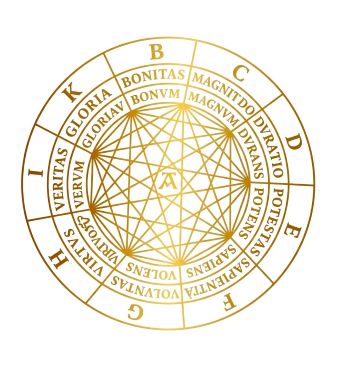
About the Symbol: The Enneagram — a nine-pointed geometric symbol (ennea meaning 'nine' in Greek, and gram a 'figure', or drawing) — was introduced to the modern Western world by George Gurdjieff, a mystic of Greek-Armenian descent, around 1916 during his lectures in Russia. Up to this point, it was strictly about mysticism, spirituality and symbolism. Nothing related to personality types.
While the existence of the Enneagram 'emblem' spans a long period, it was only in the second half of the 20th century that it was used in personality studies. The historic roots of the symbol are largely unknown because various cultures and spiritual circles through the ages have used 'similar' — although not identical — ensigns. Meanwhile, we find practically the same one used by early Christian scholars in the late middle ages [c.1305] and the Baroque period [c.1655].
to skip the development stages
After George Gurdjieff introduced it to 20th-century esoteric [mystical] teaching, in the late 1960s the Enneagram symbol was adopted by Oscar Ichazo, a Bolivian philosopher — not a psychologist — for his Protoanalysis system. Ichazo called the symbol an Enneagon at the time, and used it to describe nine distinct "ego-fixations" (or core mental habits and illusions). This was the first step to connecting spiritual liberation to later personality patterns.
Then in 1970, Dr Claudio Naranjo, a Chilean-born psychiatrist, attended Ichazo's lectures in Arica [Chile] and he integrated a psychology perspective into the framework, thereby translating mystical concepts into formal psychological language.
Since the 1980s, other psychologists continued to contribute to develop it into the Enneagram of Personality as we know it today. They added nuances like 'wings', 'levels of development', 'subtype instincts', and integration/disintegration lines, formalising it into modern psychological literature.
Motivation, or what drives us to do something, is the 'cause', and Behaviour is the outward manifestation that results and is, therefore, the 'effect'. So this is about "Cause rather than Effect."
While 'The Big Five' focuses on personality traits, the 'DISC Model' focuses on observable behaviour and the 'Myers-Briggs Type Indicator' explores a combination of energy-type, information processing, decision style and control, the Enneagram focuses entirely on people's inner drives and core motivations.
It asks why you act, not just what you do. For example, two people might both work late every night. One might work late due to a drive to achieve success, while the other works late out of a drive to feel secure. The behaviour is identical, but the inner motivation is completely different.
In the next section we shall look at what the "9 Types" represent and how to identify which types apply to you. We'll actually simplify the process for you by providing an interactive questionnaire. It makes little sense jumping into the analysis before you grasp the workings of the Enneagram, so please check out the next chapter.
Key: continue forward