In reality, almost everyone behaves like an ambivert at times. You might be naturally quiet at home, but active and social at work because your job requires it. This flexibility is completely normal.
However, performing differently from your natural state takes effort. Knowing your ‘baseline orientation’ helps you manage your energy, reduce stress, and improve your relationships both at work and in your personal life.
To understand how introverts and extroverts handle daily interactions, imagine two courier vans leaving the depot in the morning.
One is a parcel delivery van, representing our naturally introverted person, while the other is a collection van, representing our natural extrovert. Every ‘stop’ they make, whether to deliver parcels or to collect, represents an ‘interaction’ with other people.
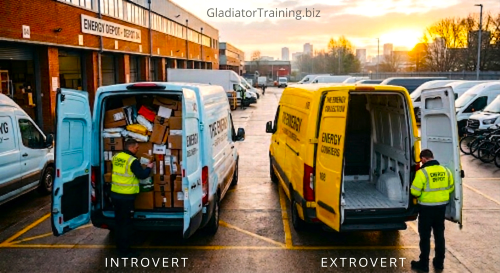
The Introvert: The ‘Delivery’ Van
An introvert starts the day with a full van of mental energy.
- The Process: Every meeting, email, phone call, or casual conversation is like stopping to drop off a parcel. With every single interaction, energy leaves the van.
- The Result: By 5:00 PM, after dozens of stops, the van is practically empty. The driver doesn't hate the people who are receiving the parcels but the van simply cannot make any more deliveries until it returns to the quiet "depot" (solitude) to reload.
The Extrovert: The ‘Collection’ Van
An extrovert starts the day with an empty van.
- The Process: Every social interaction, group brainstorm, or lively room is like stopping to pick up parcels. With every interaction, the van gains energy and momentum.
- The Result: Being left alone in a quiet room all day means the van stays empty—which feels unproductive and draining. To feel energized, the extrovert needs to get out on the road and collect energy input; noise, and connection from the world.