
Before you can understand Personality properly, you need to understand the persona concept properly. Think of a movie star who portrays different characters in several movies.
The actor, or actress, intends for us to 'see' them in a particular way. They might be playing the role of a cruel person although in real life they might be the kindest of people.
The keyword to keep in mind here is "projection," as it reflects how the actor in ancient Greece and Rome would wear a 'theatrical mask,' or "persona
 The Mask of Strategy:
Although the word ‘persona’ originates from the Latin for the ‘theatre mask,’ depicting a Character, our ability to wear a "social mask" isn't about being fake, but about social adaptation.
In high-level leadership, projecting a persona, or a calibrated set of behaviours chosen for a specific objective is essential.
source: Jungian Psychology — role.
" so the audience could identify with the story character being played.

The Persona
Let us borrow Shakespeare’s famous monologue—although here it's used within a different context—and relate this verse to the human "
persona
The Mask of Strategy:
Although the word ‘persona’ originates from the Latin for the ‘theatre mask,’ depicting a Character, our ability to wear a "social mask" isn't about being fake, but about social adaptation.
In high-level leadership, projecting a persona, or a calibrated set of behaviours chosen for a specific objective is essential.
source: Jungian Psychology — role.
" from the Jungian perspective.
And all the men and women merely players;
They have their exits and their entrances;
And one man in his time plays many parts”
In the context of Personality, these different ‘parts’ a person plays refect in the different ‘roles’ we all play in life. In each of these roles we portray different—sometimes they seem to be completely opposite—behaviours. Whether intentionally or not, we project a particular image; as we wish others to perceive us. For example, one may be pretty serious in her career and easy going in private life. Or a person might come across as a confident storyteller when making work presentations, but actually be shy and can't wait to get home to relax and recharge.
More specifically, the persona can even shift within the same role! As we explained, it's an 'adaptation' to accommodate how we wish a particular category of people to perceive us — but here's a twist: how a manager may wish to be seen at work by clients, by peers, and by junior staff might not be the same. And what if that same person were attending a Board Meeting, perhaps among seniors? That's another story altogether. Needless to say, with his mates who know him "at the bar", a completely different persona.


The same person ... plays different parts.
The Amazing Switch:
The 'Persona' as a
High-Performance Tool
Some people will argue that to perform differently from our 'Natural' Self would be inauthentic. In other words: it would be fake.
It absolutely is not! In fact, it's about Behavioural Intelligence. The act of adapting is programmed into our Human Nature; in our fundamental need for social acceptance, and for gaining or maintaining social status. Our brain has mirror neurons (cells) that are wired to make us inclined to imitate the tribe, or other people, which serves to make us look safe as well as to keep us safe. Adapting helps us gain in-roads into relationships where we might otherwise be seen as an 'outlier' (the enemy in evolutionary terms).
While we're unable to go into the detail at this level, suffice it to say that an executive who can "glide" between versions of themselves effortlessly is a master relationship builder. This is also treated in our members' dossier.
Meanwhile, consider the "Velvet Hammer"—The Warlord archetype. This persona possesses high drive to achieve results, yet filters it through tact. A strong navigator-leader. The secondary trait [tact] is often resident within a "sub-persona" that comes into play only when circumstances demand. Think of this as a sub-folder, if you will.

The Hidden Cost:
Your Behavioural Battery
Every time you "stretch" your behaviour away from your Natural Core to meet a role's demand, you are practically pulling on an Elastic Band. While this is something of a superpower, it is also stressful as it draws energy from your limited psychological battery
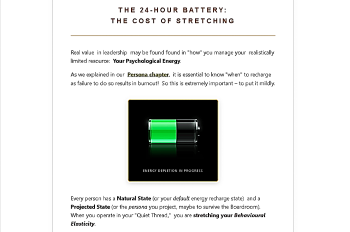 as explained in the Course – Module 2 – page.
On a related note, in Module 3, we also cover the Jungian Shadow as it applies in Leadership, as well as diving into "masking behaviour" where actions conceal opposite emotions.
Members of our inner circle will learn how to manage this tension so as to continue performing at their peak without hitting burnout.
Depending on where you were last, you may choose to return to your desired next step by following one of the following links. Please ensure you have covered them in sequence to ensure correct understanding:
Whenever you feel ready to dive deeper into our Members' inner circle, click here where more advanced material awaits you.
Edutainment: Meanwhile, if you have already completed DISC modules 1 and 2, you may also go to the Theatre where we demonstrate the DISC Archetypes in action as they are reflected in some of your favourite Screen characters from famous movies, TV series and sitcoms. There, you may also enjoy related quizzes.
Examine the behaviours of your favourite Screen characters.
Choose your Arena and begin the demonstration.