This document isn’t meant to sound like some high-stakes tactical intelligence manual, but as those who are already navigating the top tiers of power will tell you, "it pays to be able to read people and predict outcomes as best as you can." Learning how to de-code Behaviour is one of your priceless tools in your people skills.
So in this section, we continue explaining the DISC Method essentials leading right up to the advanced programme for our
"
inner circle
Visit our "Archive" where you can explore our Free Access and the Members-Only material listings.
You will find highly researched material, like Your Strategic Style 'Audit' with Dossiers and downloads, the Big 5 / DISC Personality Quizzes, Negotiation briefings, Practical Leadership & Effective Communication material, Productivity/Prioritizing Notes and many more essential subjects of value.
"
where we provide our Members the study material and a printable manual. But even at this level we are pleased to provide non-members with important material. Read on.
We are all different — We are individuals
You are a Living Mosaic
What is your personality type? Forget rigid color-coded “boxes” because in life, and more so in business, "pure types” are a personality myth — a gross over-simplification.
You are a unique hybrid, or blend, of 4 Energies—a living mosaic where your primary Drive (what you need, or want) is filtered through your primary Tool (how you are programmed to get it). Did you get that? You will, in a moment.
Before we revisit the 4 DISC Quadrants and what they stand for in a bit more detail, first we must consider these 3 essential rules:
No one person is a single ‘type’ — i.e. a pure “D”, or a pure “C”. We each exhibit a dominant, or primary ‘natural’ tendency, but we also have a secondary, and generally even a tertiary tendency. We are a mix of the different types in different proportions.
People shift between 'personas' — During any single day, people shift from one 'persona' to another to accommodate the needs of each different 'role' we play.
Why does this happen? — The shifts are a form of coping mechanism to help us navigate situations that our natural tendencies might not be suited for. These roles are referred to as your ‘adapted’ personas and while adapting is necesssary, it still carriers an "energy cost"!
The four divisions of DISC characteristic behaviours are explained below:
Typical behaviours hint at personality types
“D” — Dominant behaviour (Red) that is often reflected in:
Direct communication – others may feel this is ‘blunt’
Determination—a person who’s action- and results-driven
Decisions that are quick (maybe sometimes even hasty)
Competitiveness – risk taker; demanding; expects to win
Assertive body language (stance, gestures, voice)
“I”— Influencing behaviour (Yellow) that is often reflected in:
Inclusivity – an organiser, loves groups; typically extroverted
Fun – a people person, the soul of any activity
Talkativeness – animated, expressive communicator
Optimism – a motivator; looks for the silver lining
Flexibility – typically less fussy about procedure
“S”— Stable behaviour (Green) that is often reflected in:
Sensitivity – cares about how people feel; caretaker; helper
Cooperation – avoids conflict as much as possible; the peacemaker
Steady pace – careful and never hasty (typically slower paced)
Consistency – prefers predictability (certainty) over surprises
Loyalty – the calm within the storm; the team’s go-to person
“C”— Conscientious behaviour (Blue) that is often reflected in:
Reservedness – prefers to work alone, reflective; a typical introvert
Compliance – a rule maker and follower; procedure is king!
Economic – speaks and moves less than others; often serious
Precision – data driven, cares about facts more than opinions
Rationality – level headed logic and rationale over emotion
The Persona
We all wear a persona—a clever psychological mask that lets us adapt our behaviour to fit whatever role life demands.
But constantly flexing away from your true self drains your psychological battery, and pulling on that elastic band for too long comes at a hidden cost. as we shall see in this next step.
Anyone who wishes to dive deeper into Personality or any of the topics treated in even more depth in our Members' inner circle, may click here for the more advanced material that our members enjoy.
Edutainment: Meanwhile, if you have already completed DISC modules 1 and 2, you may also go to the Theatre where we demonstrate the DISC Archetypes in action as they are reflected in some of your favourite Screen characters from famous movies, TV series and sitcoms. There, you may also enjoy related quizzes.
Examine the behaviours of your favourite Screen characters.
Choose your Arena and begin the demonstration.
Select your next tactical move: either proceed to the Tactical Assessment, or if you're already a member continue exploring the parameters of the DISC framework.

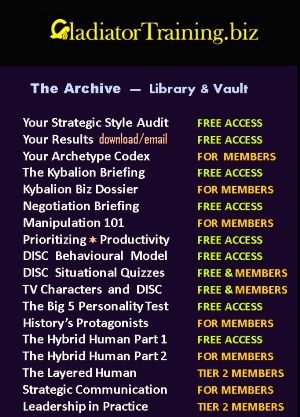 Visit our "Archive" where you can explore our Free Access and the Members-Only material listings.