
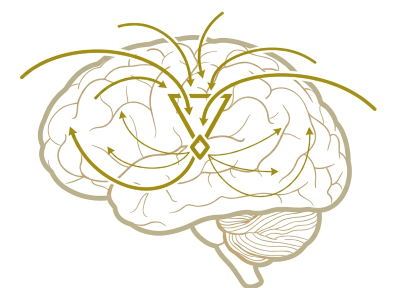
Gladiator Training Logo
Reticular Activating System

Reticular Activating System

The Brain's Front Office Manager

For convenience, we refer to it as the "RAS".  It is one of the more important parts of our brain because  without it, your brain would quickly become overwhelmed by everyday background noise.

In short,  the Reticular Activating System (RAS)  is a network of nerves in the brainstem  that acts as your brain’s main filter and control centre for awareness.  Every second, it processes huge amounts of incoming sensory data,  letting through  only  the information  that is important or relevant to you.

It also regulates your 'sleep-wake' cycle,  helping you wake up,  to stay alert,  and to direct your focus where it is needed.

Your Information Control System

As your brain’s main control centre, it regulates your wakefulness and focus, filtering data being received by your brain in quantities that would crash any known computer.  Ignoring the sounds and sights that are common, everyday occurrences is essential if you are to function properly.  It is as important as—if not more than—focus!
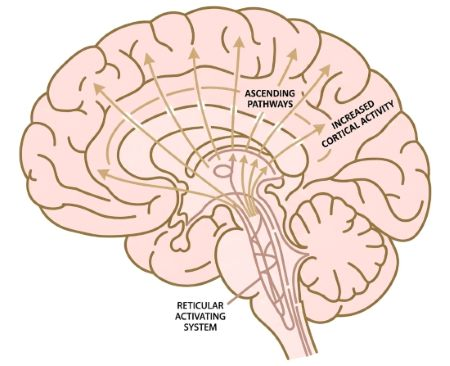
Prioritizing and Distribution Centre

Let's look at its functions:

  • The Brain's Filter:  Every second, your senses receive millions of pieces of information.  The RAS acts like a gatekeeper,  filtering out background noise  (like traffic) so you can focus  only on what matters.
  • Sleep and Wakefulness:  It controls your sleep-wake cycle.  It "wakes up" your brain in the morning to make you alert  and winds down when it is time to sleep.
  • Selective Attention:  When you decide something is important—such as listening for your name in a noisy crowd—the RAS makes sure you notice it immediately.

The RAS and Intro-/Extroversion

In a nutshell,  the RAS decides what gets your conscious attention  and keeps your brain awake and alert.  Now, let's see how this works

The Reticular Activating System also plays a central role in how introversion and extraversion work.

This link was first proposed by psychologist Hans Eysenck in his Cortical Arousal Theory of Personality.  The core difference comes down to  the RAS acting as a "baseline arousal knob" for the brain  as explained below.
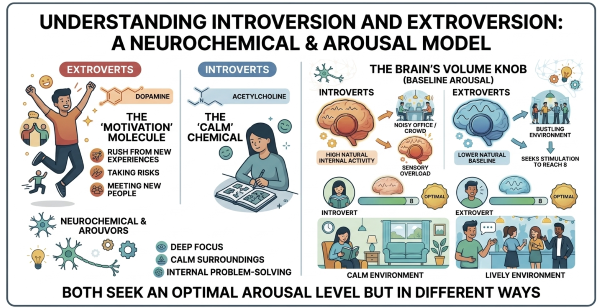
Different Brain Functioning between Extro- and Introversion

1. The Introvert Brain: High Baseline Arousal

  • The Biology: Introverts naturally have higher resting/baseline levels of activity in the RAS (a lower threshold for arousal).
  • The Result: Because their brains already process a lot of internal stimulation, introverts don't need much environmental input to hit their optimal arousal zone.
  • Behavior: Highly stimulating environments (like loud parties, busy offices, or large crowds) push the RAS past its sweet spot into sensory overload. Introverts seek quiet, calm spaces to keep their RAS from becoming overstimulated.

2. The Extravert Brain: Low Baseline Arousal

  • The Biology: Extraverts naturally have lower baseline activity flowing through the RAS (a higher threshold for arousal).
  • The Result: At rest, an extravert's brain operates slightly "under-aroused" compared to an introvert's.
  • Behavior: To bring their RAS up to the optimal arousal zone, extraverts naturally seek out external stimulation—action, socializing, music, and new environments—to energize their nervous system.

Summary

Reaching the "Optimal Zone"

Both introverts and extraverts strive to reach the same level of mental comfort and cognitive efficiency (following the Yerkes-Dodson Law).

The Difference:

  • Introverts use their environment to turn down the volume on an already loud RAS.
  • Extraverts use their environment to turn up the volume on a naturally quiet RAS.
Have you explored the
or return to
energy management
preamble to Personality