
EXPLAINING THE VECTORS

In Part One we explained that the five traits are universal, spanning across cultures. Now, it is important to understand how every vector works.
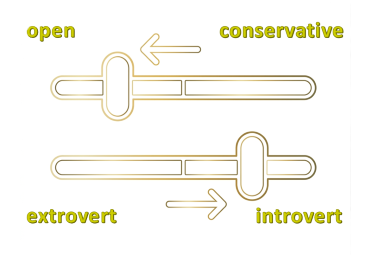
Every trait [or vector] operates on a sliding scale.
To simplify the idea, think of each dimension as stretching from an ultra-structured approach on one end to an ultra-flexible (or reactive) approach on the other.
It's not about "good" if you've got it, and "bad" if you don't.
What it is about is a sliding scale where most people are (depending on their circumstances or the role they'd be in) somewhere in between.
The diagram shows 'Openness' to experience at one end of the scale and 'Conservative' approach at the other, 'Extroversion' at one end and 'Introversion' at the other. A score — high or low — simply indicates 'where' on the spectrum a person is.
1. Openness to Experience (O)
2. Conscientiousness (C)
3. Extroversion (E)
4. Agreeableness (A)
5. Neuroticism (N)
Have you ever come across a 'shy' extrovert? Or perhaps an introvert who operated confidently in groups?
Be sure to explore the Introvert or Extrovert section to confirm your understanding aligns with accepted concepts and access/download your Cheatsheet.
In the Members' inner circle we deal with 3 Composite Profiles (High/Low Permutations of different vectors), and The Jungian "Persona" Shift from the perspective of the Big 5 framework.
Visitors may take the Big 5 Assessment, remembering to answer in line with how you would act within your professional persona, in this case your work role.