The human being is complex, calibrated organism and Personality is just one of at least five layers of conditioning that shape who we are, as we explain in our "Layered Human
 Understanding what drives behaviour is crucial so as to conduct relationships more consciously and beneficially: We'll unveil intriguing hardwired programming, revealing humans as a product of external conditioning more than 'will,' where 'personality' is a higher layer...
" framework.
Understanding what drives behaviour is crucial so as to conduct relationships more consciously and beneficially: We'll unveil intriguing hardwired programming, revealing humans as a product of external conditioning more than 'will,' where 'personality' is a higher layer...
" framework.
Layered Conditioning: The deepest layer of our physical and mental makeup is human nature. This layer drives our automatic and involuntary actions, reactions, and thoughts. At its core is the instinct for survival, which forms the base of Maslow’s Hierarchy of Needs
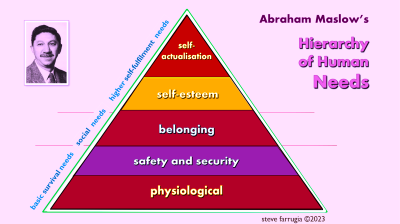 " framework.
Higher up these layers sits our personality. Personality is partly inherited from our genetic background and partly shaped by our environment and life experiences.
Many people are interested in astrology. This interest highlights a natural human tendency: our desire to categorise people into groups. Astrology uses 12 zodiac signs to represent different "types" of people.
In the scientific study of personality, we do something similar, but with a more evidence-based approach. While every person is a unique individual, studying eight billion separate personalities is impossible. Therefore, frameworks group humans into a small number of "personality types". This helps us better understand human traits and behaviours.
There are several popular frameworks used today. While only one is fully backed by academic consensus, the others remain highly practical tools for personal development and for corporate efficiency.
The Big Five (OCEAN)
This model is widely considered by psychologists to be the most scientifically reliable. It measures five core traits: Openness, Conscientiousness, Extraversion, Agreea bleness, and Neuroticism. A person is scored along a spectrum for each trait.
Explore the Big 5 ▶
The Myers-Briggs Type Indicator (MBTI)
Created by Katharine Cook Briggs and her daughter Isabel Briggs Myers, this system builds on the theories of legendary psychiatrist Carl Jung. It is highly popular in corporate training and divides people into 16 distinct personality types based on four preferences.
Explore Myers-Briggs ▶
The Enneagram
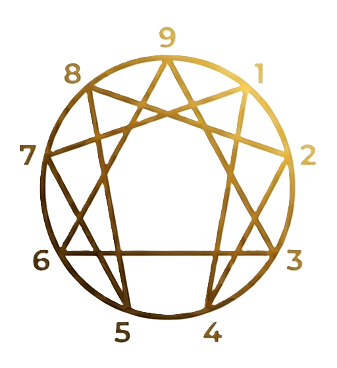
This model uses nine primary personality types. It focuses on a person's core motivations and fears, suggesting that while we have a dominant type, we also share traits with neighbouring types.
Explore the Enneagram ▶
The DISC Behavioural Model
Developed by psychologist William Moulton Marston, this framework connects to ancient behavioural concepts. It uses four main categories: Dominance, Influence, Steadiness, and Compliance. Most people have a dominant quadrant, followed by secondary and tertiary traits.
Explore the DISC Model ▶
In this website, we particularly cover the DISC framework in detail. However, it is important to remember that no personality is completely fixed.
People naturally change their behaviour throughout the day. We move in and out of different "personas" depending on our current role, environment, and circumstances. Understanding these frameworks helps us navigate these changes and improve how we work with others.
Choose which of the frameworks, above, you would like to explore first or click the button to continue exploring in sequence.

