Different people use different ways of thinking—we process thoughts using different thinking styles. Some people are fast to arrive at a conclusion. Others take their time. Some people see possibility in everything, while others see risk. Some people think in big chunks, while others consider detail. Some people focus on facts while others are led by emotion.
This diversity can be very productive IF it can be harnessed and coordinated in the same way that very different instruments come together in a great orchestra. But this is only one side of the story. People usually believe that their opinions are the correct ones and oppose different views.

This means that diversity can just as easily create conflict and stall progress. So we're rather lucky that Prof. Edward de Bono (the originator of "Lateral Thinking") gave us the Six Thinking Hats method. This is a powerful technique that promises focus and coordination over dominance of egos and vagueness.
Rather than opposing each other, or perhaps passively accepting every proposal made by the more dominant personalities, here the meeting participants ALL apply the same thinking style as a unified team. By "wearing the same thinking hat" for a limited period at a time, the whole team collectively seeks a particular thinking objective, until it's time for everyone to wear the next hat, then the next, and so on. How does this work in practice?

Each 'Thinking Hat' has a purpose — a role and a different style.
- The meeting is chaired by the "one" person assigned the Blue Hat .
This particular Hat has the special role of "leading" the meeting so that—besides wearing all the other hats in sequence—the person wearing the Blue hat will also:
- remind what the Agenda is, what is to be achieved [meeting's objective/s];
- lay out the procedure to be followed—the "hat" sequence and thinking style;
- briefly summarise each stage, before
- calling up the next 'hat' until it's time to
- recap and close the meeting.
- The sequence now begins with the White Hat which establishes facts!
This Hat is ONLY concerned with "facts" that are verifiable; NOT with rumours or notions, but facts that are known to be true. The White Hat keeps everyone grounded on solid rationale and away from gossip, hearsay, or second-hand news.
- The second thinking style, the Red Hat allows everyone to voice their gut feelings.
This Hat is less rigid and doesn't insist on cold "facts" because it's intended to allow everyone to vent their feelings. The Red Hat is the voice of emotion. Whether you wish to say you're excited about the subject, or to voice your fears, that's fine. And now that that's out of the way ...
- The third thinking style, the Green Hat brings the ideas to the table.
This Hat is about 'creativity' so everyone is expected to generate "options," and bring up "possibilities". Here's how that might sound: "What if we increased our budget on this?" or "Hey, maybe we could even partner with [competitor 'X'] rather than have to compete with them aggressively!" to "How else can we ...?" The Green Hat is where Lateral Thinking breathes life into the brainstorming.
- The fourth thinking style is the Yellow Hat and this requires everyone to voice the "benefits" that can be derived from this idea. ONLY benefits..
This Hat forces the 'upside perspective' so anyone who came to the meeting heavily biased against the idea will now consider that – like most things – this too has its advantages, even if they are still not convinced.
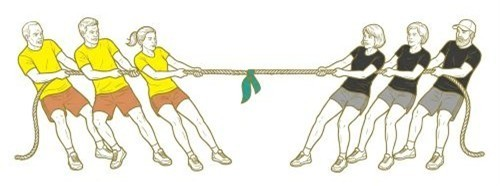
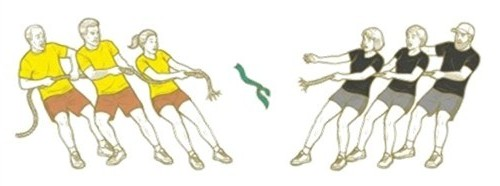
Yellow optimists versus Black pessimists
Why work against each other when we can cooperate?
- The fifth thinking style is the Black Hat that is our "Devil's Advocate"—the voice of caution—which must ONLY look for weaknesses..
This might be called the 'voice of reason', the stress test to make sure the project will float before it launches – if it is to go ahead – so those who are the most risk averse will attack the idea from every angle. But as you can see, every phase is essential.
- And we're back to the Blue Hat to summarise and close the meeting.
Having ensured that, if possible, everyone participated and within the expectations of the coloured hats the Blue Hat then summarises the agreed points–and hopefully the conclusions reached–bringing the meeting to an end.