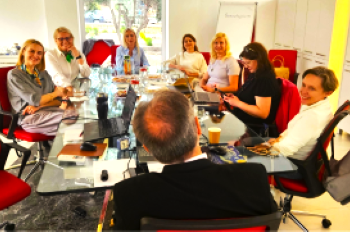
2018 saw the launch of Life Coaching Malta's workshops — a series that evolved into full training courses in life-skills and mind-skills. Material from these sessions was later incorporated into specialised modules delivered for/on behalf of professional training organisations
 .
.
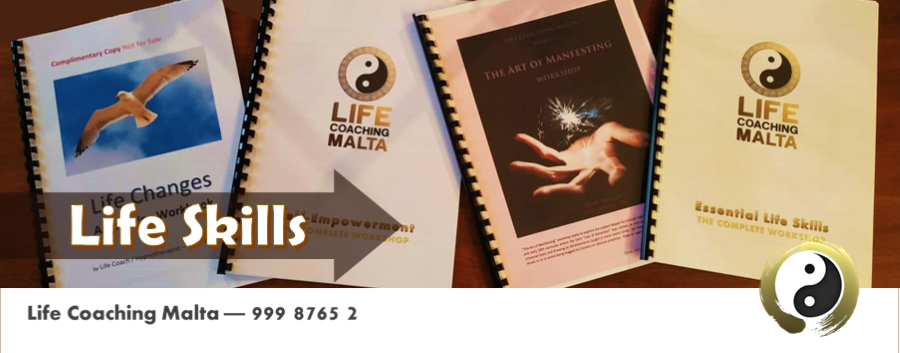
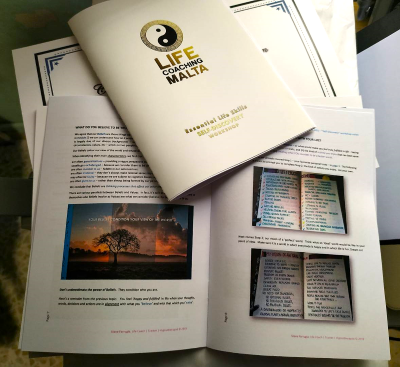
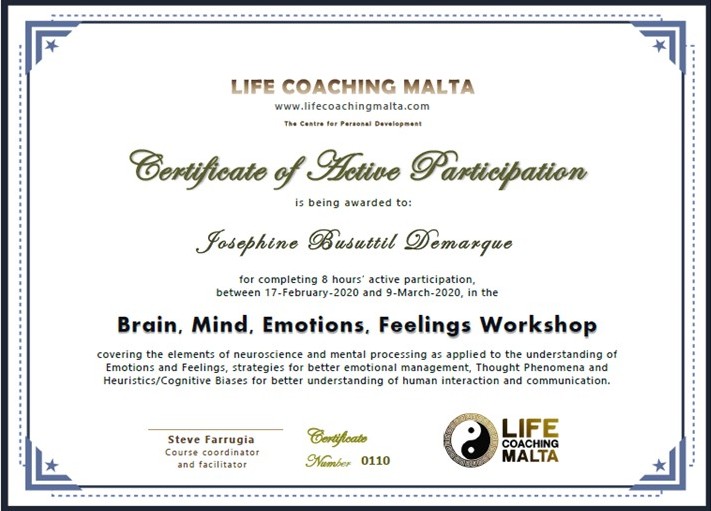
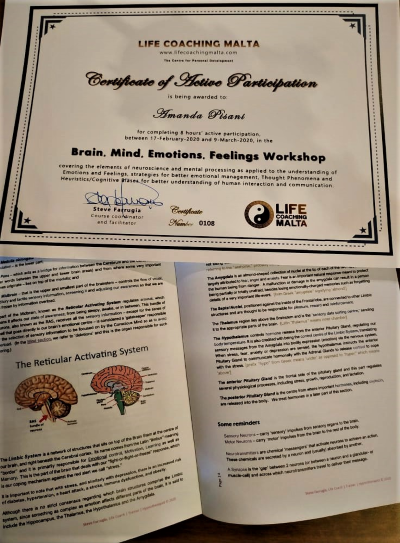
Every workshop comes with a unique printed notes booklet, exercises and a participation Certificate
 . The language used — English or Maltese — depends on the group's nationality and language fluency.
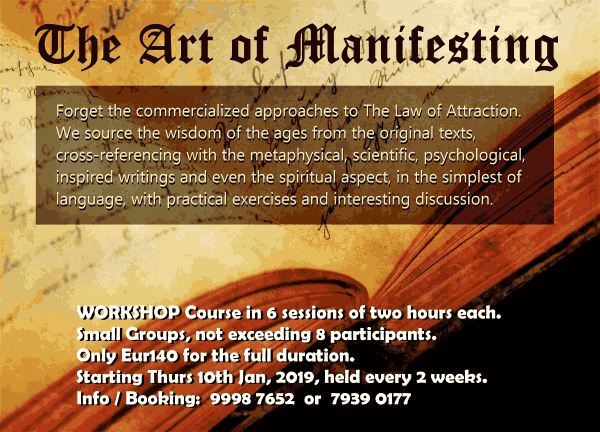
The full original programme covered the following four areas, later expanded into stand-alone Modules, and this was followed by 'The Art of Manifesting' specialist workshop:
The foundation course
Essential Life Skills
This first workshop was expanded and divided into four individual modules, each made up of four 90-minute sessions. These separate courses were:
- Self-Discovery
- Brain-Mind, Emotion-Feeling
- Goal-Setting and Motivation
- Worry, Anxiety and Stress
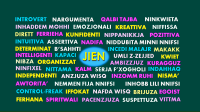

Module 1—The most popular session
Self-Discovery
This has always been the most popular workshop — probably because it lays the foundation for everything that follows, explaining the essential principles of personal development.
The programme opens with the Life Wheel exercise, which assesses each participant's satisfaction across ten important areas of life, to work out:
- which areas fall below their personal average and so require attention;
- in which order these should be tackled; and
- what they're actually going to do about it.
We explain how every individual carries different personas — the various roles we play in life — a cornerstone in the understanding of "personality," which is the very foundation of Leadership and Communication training. The Me-Map video (right) is merely a taster of this but training, and this website, will explain its importance.
The Self-Discovery course covers Self-Love, self-respect and -esteem, your life balance, and we conclude with each participant establishing their Life Mission, often referred to as 'purpose' — but there's more! We cover Responsibilities (understanding what's yours to carry, and what isn't), common misconceptions about Beliefs and Values, since these two underlie every decision you'll ever make. We also cover Ikigai, Hygge and a few other useful concepts upon which your Personal Development journey will depend.
Module 2
Brain-Mind,
Emotion-Feeling
This module looks at human evolution to show how certain basic needs haven't changed since homo sapiens emerged around 300,000 years ago — and in some ways even since homo erectus, roughly four million years back. This becomes relevant to understand behaviour.
The Brain
The «primitive» part of our brain has remained largely unchanged, though the brain has developed greatly in other respects. We explore the structure and some important functions of the physical brain — your body's control centre — including the nervous system/s, neurotransmitters, hormones, and the foods (and toxins) that affect it.
The Mind
Next, we turn to the non-physical function — the virtual mind — classifying it into the "Conscious" (reasoning) mind and the "AlterConscious," made up of the Subconscious and Superconscious states.
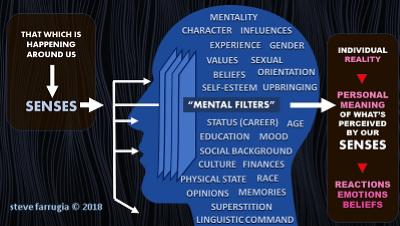
We see how, for our own good, our brain only allows us to notice part of what's happening around us — our sensory intake is limited — so we'll examine the Perception Model: how the subconscious conditioning filters and processes that intake of data to create "meaning". We also look at stress as a natural and necessary response, and the difference between (physiological) emotions and (psychological) feelings.
Because perception involves interpretation, meaning takes shape as thoughts, which in turn produce feelings — so what we feel is often a result of how we interpret our environment, and that can change as soon as our perspective changes. That's the part we can control.
The module also covers the subconscious mind at work, the Covey 90/10 principle, our mental "representation" system, the idea of individual reality (one's own "model of the world"), heuristics and cognitive biases that distort our thinking, cognitive dissonance, and the limbic system as the seat of emotion — closing with practical strategies for shifting your state of mind when you're feeling troubled or stressed.
It's a fairly intensive programme with a somewhat technical approach to the Brain–Mind relationship — one that aims to show how our limited locus of control can be optimised to help us live more satisfied lives.
Module 3
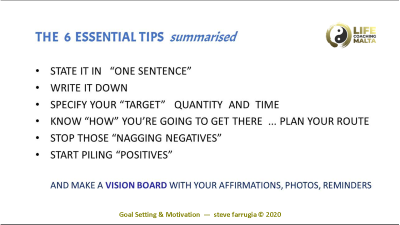
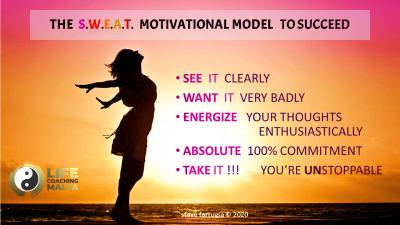
Goal-Setting & Motivation
Parts of this module had been incorporated in my training given on behalf of AcrossLimits' Erasmus+ sponsored "Weight Matters" programme, designed to help participants set and reach their weight-loss goals.
In such training, whether aimed at the general public or business executives, SMART goals are explained in the simplest language and easily relatable terms. We expose the common mistakes people make when setting Goals and explain how to reduce the friction.
What does "being specific" actually mean?
"I want to lose 12kg" sounds specific enough to most people — but the subconscious mind doesn't do arithmetic; it can't process what "64kg minus 12kg" means. "I am reducing to 52kg" gives your 'control centre' something concrete it can actually understand and follow through.
Here's a further trick: The Affirmation "I am fast becoming a size 6" is even more effective, because it's visual. Now THAT is what being specific feels like; something that can be grasped, not 'in the air' targets.
What is motivation?
This part of the programme is more coaching than training — understanding what drives us so we stay hungry for the goal. Ultimately, you need to know why the goal matters to YOU.
Do you know about the story of the 'horse,' the 'Christmas staff party' and the 'water trough'? Once you hear it, you'll understand its relevance to motivation. That's one for Training.
Module 4
Worry, Anxiety & Stress
There's a real difference in severity between "being concerned" and "worrying" about something — and, as a matter of character, some people worry more than others.
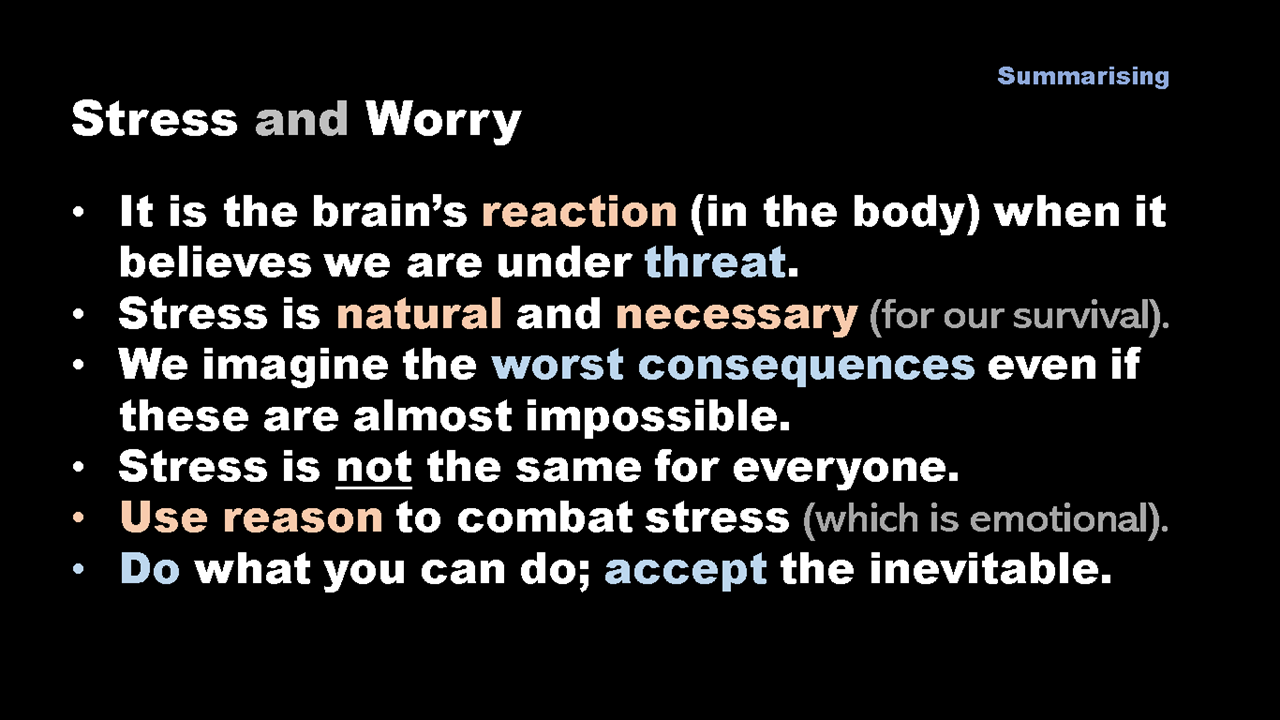
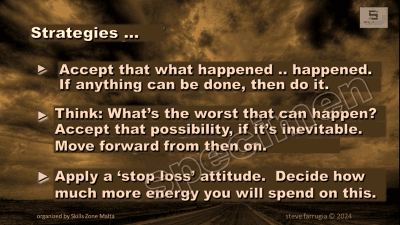
Worry doesn't solve problems; it drains energy and clarity, and can tip into anxiety and stress severe enough to cause real harm, mentally and physically. This module explains how worry feeds on uncertainty and thrives in vagueness — and sets out a method for regaining rationality: either take action to resolve the problem, or accept what can't be solved about it.
Anxiety often paralyses the body and stops people performing at their best — perhaps the most obvious example is "stage fright." So we look at ways to tackle this fear, which is rarely based on 'real danger' and almost always on imagined consequences and negative self-talk. It's the same anxiety that holds people back in job interviews and competitions.
Stress needs to be understood for what it is — it's a natural, necessary response that's meant to keep us safe, even though it often does more harm than good in modern life. Understanding it is the first step; this module gives you the practical strategies to cope with both stress and the anxiety that comes with it.