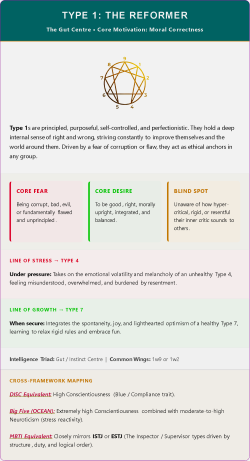
Unlike some static personality profiling tools, the Enneagram takes into consideration shifts in your day to day emotional conditions. The symbol itself – its Geometry – will help you. Just follow the instructions and it all falls in place. Inner lines in the diagram connect each core type to two other numbers on the circle:
- Line of Stress (Disintegration):
Under prolonged pressure or overload, you borrow the reactive, uncharacteristic traits of another type — e.g. a typically organized Type 1 becoming scattered like an unhealthy Type 4.
- Line of Growth (Integration):
When feeling secure, grounded, and self-aware, you access the high-functioning strengths of another type — e.g. a guarded Type 5 moving towards the decisive, grounded leadership of an integrated Type 8.
Understanding your lines of movement allows you to recognize stress indicators long before burnout occurs, and provides an actionable blueprint for personal growth.
Every 'core type' is further refined by three primary biological instincts, creating 27 distinct subtype variations:
- Self-Preservation (SP):
Focuses on physical safety, comfort, resource management, and risk reduction.
- Social / Group (SO):
Focuses on in-group status, community standing, group dynamics, and duty.
- Sexual / One-to-One (SX):
Focuses on intensity, deep personal connection, drive, and personal chemistry.
Two individuals of the same core type (e.g. two Type 6s) will present completely differently if one operates primarily from a Self-Preservation instinct (cautious, warm) while the other operates from a Sexual instinct (counter-phobic, assertive, challenging threat directly).
It's obviously easier to consider these individual mechanics—Core Types, Wings, Dynamic Lines, Tritypes, and Instinctual Subtypes—as separate puzzle pieces. But in reality, they operate simultaneously, as a sort of weave, to form your unique psychological signature.
Before we proceed to the conclusion, here are some reminders of the various components:
- Your Core Type represents your primary emotional engine, your core desire, and baseline fear.
- Your Wings supply the immediate, daily nuance and an operational flavour to your core strategy.
- Your Instinctual Subtype directs where your primary energy and attention are deployed (Self-Preservation, Social, or One-to-One).
- Your Dynamic Lines map how your behaviour adapts under pressure or evolves during personal growth.
- Your Tritype reveals your complete three-centre coping strategy across Gut, Heart, and Head intelligences.
"The Enneagram does not put you in a box; it reveals the box you are already in and shows you the way out."
Rather than confining you to a static label, this framework demonstrates that human personality is both structured and remarkably fluid. Discovering your configuration provides a practical mirror for self-awareness, communication mastery, and emotional regulation.
Now that we've explained the foundational architecture, wings, and growth lines, you might be ready to identify your own core drive and map your personal developmental pathways. Remember, there is an interactive assessment questionnaire later on to help you, so you will get there anyway.
Understanding the Enneagram isn't about learning complex jargon. It's about following a clear, step-by-step diagnostic path. So here is how you bring all the pieces together to find your complete personality profile:
-
Identify Your Core Type (Your Emotional Engine):
Read through the 9 Core Types.
Look for the underlying motivation, the core fear, and core desire that have driven you across your entire life—not just at work today. This gives you your primary number (e.g., Type 1).
-
Determine Your Wing (Your Daily Flavour):
Look at the two numbers directly adjacent to your Core Type on the circle.
Decide which neighbour exerts a stronger influence on your daily style.
If you are a 'Type 1,' you can only have a '9-Wing' (1w9: calmer, detached) or a '2-Wing' (1w2: warmer, active).
-
Discover Your Tritype (Your 3-Centre Strategy):
Select your most dominant strategy from each of the three 'Centres of Intelligence':
- Gut Centre (8, 9, 1):
How you handle instinct and boundaries.
- Heart Centre (2, 3, 4):
How you handle feeling and identity.
- Head Centre (5, 6, 7):
How you handle thinking and security.
Combine these three numbers with your 'Core Type' leading the sequence (e.g. 1-3-5).
-
Map Your Dynamic Movement Lines (Stress & Growth):
Follow the fixed geometric lines connected to your 'Core Type' on the Enneagram symbol:
- Note your Stress Line to spot early warning signs of burnout.
- Note your Growth Line to identify the healthy behaviours to cultivate when secure.
-
Apply Your Subtype Instinct (Your Primary Focus):
Identify which biological drive takes priority in your daily life: Self-Preservation (comfort/safety), Social (status/community), or One-to-One (chemistry/intensity).
Your Final Enneagram Signature:
By completing this process, you move from a single static number to a rich, fluid profile (for example: "Type 1w2 | Tritype 1-3-5 | Social Subtype"). This gives you a precise map for communication, leadership, and personal growth.
Are you ready for your final step?
MEMBERS may proceed here.
▼
▲
9 Enneagram Cards
and detailed Assessment